
Backed by 2,700+ successful finance transformations and a robust retained earnings partner ecosystem, HighRadius delivers rapid ROI and seamless ERP and R2R integration—powering the future of intelligent finance. Business News Daily provides resources, advice and product reviews to drive business growth. Our mission is to equip business owners with the knowledge and confidence to make informed decisions. Writing off meals and entertainment for your small business can be pretty confusing. Both the Democratic and Republican candidates for president have pledged to make certain changes to the tax code that will affect small business owners. For the second year of depreciation, you’ll be plugging a book value of $18,000 into the formula, rather than one of $30,000.
Order to Cash Solution
To learn how to handle these contingencies, please see our Beginner’s Guide using the above link. The book value of an asset, seen on the above chart, is the asset’s original cost, less any accumulated depreciation. Any impairment (weather, fire, accident) that may befall an asset is also subtracted. To record the depreciation expense each year for this asset, we enter a journal entry that debits Depreciation Expense $4,000 and credits Accumulated Depreciation $4,000. As you can see in the previous chart, the depreciation expense using the Double-declining method in year four was $864, so we have a winner! In year one, the depreciation expense is twice that of the straight-line method, or 2/5 (40%) of $10,000, which equals $4,000.
- However, as depreciation expense decreases in subsequent years, net income becomes comparatively higher.
- Next year when you do your calculations, the book value of the ice cream truck will be $18,000.
- However, accelerated depreciation does not mean that the depreciation expense will also be higher.
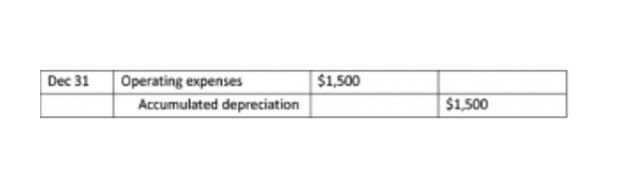
- To understand the adjusting entries for depreciation, we look back at our example above.
- Learn the most important formulas, functions, and shortcuts to become confident in your financial analysis.
The DDB method as an accelerated depreciation technique
Declining Balance Depreciation is an accelerated cost recovery (expensing) of an asset that expenses higher amounts at the start of an assets life and declining amounts as the class life passes. The amount used to determine the speed of the cost recovery is based on a percentage. The most common declining balance percentages are 150% (150% declining balance) and 200% (double declining balance).
Double-Declining Balance (DDB) Depreciation Method: Definition and Formula
Compared to the sum-of-the-years’ digits method, which also accelerates depreciation but less aggressively, DDB provides a more significant front-loading of depreciation expenses. This makes DDB ideal for assets that lose value quickly, while straight-line might be better for assets with a more uniform usage and value decline over time. The double-declining balance (DDB) method is a widely used asset QuickBooks ProAdvisor depreciation method. It’s a form of accelerated depreciation that allows businesses to allocate a higher portion of an asset’s cost as an expense in the earlier years of its useful life. Some companies use accelerated depreciation methods to defer their tax obligations into future years. It was first enacted and authorized under the Internal Revenue Code in 1954, and it was a major change from existing policy.
Application Management

Additionally, any changes must be disclosed in the financial statements to double declining balance method maintain transparency and comparability. Current book value is the asset’s net value at the start of an accounting period. It’s calculated by deducting the accumulated depreciation from the cost of the fixed asset. Accountants use the straight line depreciation method because it is the easiest to compute and can be applied to all long-term assets. However, the straight line method does not accurately reflect the difference in usage of an asset and may not be the most appropriate value calculation method for some depreciable assets. It is important to understand that although the charging of depreciation affects the net income (and therefore the amount attributable to shareholders) of a business, it does not involve the movement of cash.
- Using the rate from the calculation above, the declining balance depreciation for each of the 4 years is as follows.
- Declining balance method of depreciation is an accelerated depreciation method in which the depreciation expense declines with age of the fixed asset.
- This results in depreciation being the highest in the first year of ownership and declining over time.
- At that point, depreciation stops, or a switch to Straight-Line is applied to reach the salvage value more smoothly.
- In that case, we will charge depreciation only for the time the asset was still in use (partial year).
- For example, some technologically advanced equipment or devices may become obsolete gradually as new products come to the market.
- The straight-line depreciation percentage is, therefore, 20%—one-fifth of the difference between the purchase price and the salvage value of the vehicle each year.
Accelerated depreciation methods can reduce your taxable income upfront, freeing up cash for investments. The double-declining balance method accelerates the depreciation taken at the beginning of an asset’s useful life. Because of this, it more accurately reflects the true value of an asset that loses value quickly. When you drive a brand-new vehicle off the lot at the dealership, its value decreases considerably in the first few years. Toward the end of its useful life, the vehicle loses a smaller percentage of its value every year.